
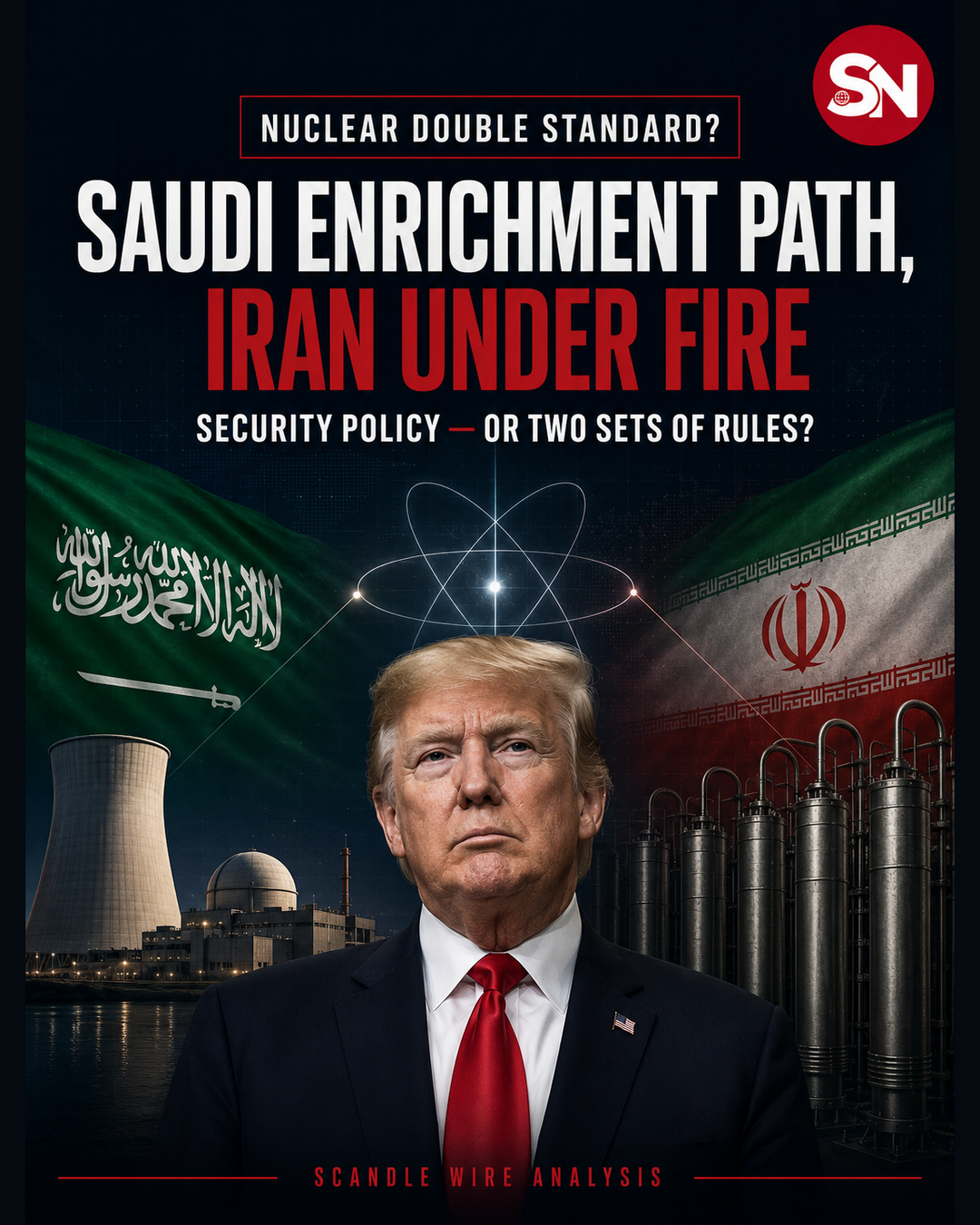
The Trump administration is preparing to ask Congress to approve a long-term civil nuclear cooperation agreement with Saudi Arabia that could eventually open a path to domestic uranium enrichment. At the same time, Washington has treated Iran's enrichment programme as a central security threat. The contrast has produced an unavoidable question: is the United States applying one nuclear rule to an ally and another to an adversary?
The allegation of a double standard has real evidence behind it, but the comparison needs precision. Saudi Arabia is not currently operating a commercial uranium-enrichment programme. According to Reuters and the Associated Press, the proposed 30-year agreement could allow a Saudi enrichment facility only after a joint U.S.–Saudi study. It would create a legal framework for American civil nuclear cooperation; it does not automatically transfer centrifuges or give Riyadh a nuclear weapon.
Even so, the safeguards reportedly missing from the agreement are significant. It does not adopt the so-called Gold Standard used in the U.S. agreement with the United Arab Emirates, under which the UAE renounced domestic enrichment and the reprocessing of spent nuclear fuel. Reporting also indicates that the Saudi pact does not require the International Atomic Energy Agency's Additional Protocol, which gives inspectors broader access to information and nuclear-related locations.
Those omissions matter because uranium enrichment is a dual-use technology. Low-enriched uranium can fuel civilian reactors, but the same basic centrifuge infrastructure can be reconfigured or expanded to produce material closer to weapons grade. Saudi Crown Prince Mohammed bin Salman has previously said that if Iran developed a nuclear bomb, Saudi Arabia would seek one as well. That statement does not prove a current weapons programme, but it makes weak inspection conditions harder to dismiss.
Iran's position is different in several important ways. Tehran already possesses a large enrichment infrastructure and has accumulated uranium enriched to 60 percent uranium-235. Civilian power-reactor fuel is normally enriched to much lower levels, while weapons-grade material is generally associated with about 90 percent. The IAEA has repeatedly described Iran as the only non-nuclear-weapon state producing and accumulating uranium at 60 percent and has raised unresolved safeguards questions.
Iran says its nuclear work is peaceful and points to the Nuclear Non-Proliferation Treaty, which recognises the right of member states to develop nuclear energy for peaceful purposes under safeguards. Enrichment is not explicitly prohibited for every non-nuclear state. The international dispute is therefore not simply about whether Iran may possess scientific knowledge; it concerns enrichment levels, stockpile size, inspection access, unresolved nuclear material and the time required to produce enough highly enriched uranium for a weapon if Tehran chose to do so.
That technical distinction explains part of Washington's argument. U.S. officials can say Saudi Arabia is a partner beginning a supervised civilian programme, while Iran has years of disputed activity and strained cooperation with inspectors. Secretary of State Marco Rubio has insisted that any Saudi agreement will not lead to proliferation, and supporters argue that American involvement would provide more oversight than leaving Riyadh to seek Russian or Chinese technology.
But the political inconsistency does not disappear. If enrichment technology is considered too dangerous for Iran because it could shorten the route to a bomb, the same risk does not become harmless when the recipient is a U.S. ally. A durable non-proliferation policy should be based on transparent limits, intrusive verification and equal standards—not simply on whether Washington trusts today's government.
Commercial and strategic interests also shape the policy. The Saudi programme could be worth tens of billions of dollars to American nuclear companies, deepen U.S.–Saudi relations and prevent Russia or China from gaining influence over the kingdom's energy sector. Iran, by contrast, is a regional opponent under extensive sanctions. These differences help explain the policy, but they also strengthen the argument that geopolitical alignment is influencing how nuclear risk is judged.
Congress has not yet delivered the final word. A U.S. nuclear cooperation agreement must go through a statutory review process, and lawmakers from both parties may challenge the absence of stricter safeguards. The precise enrichment arrangements could also depend on the promised joint study and later technical agreements. Claims that Saudi Arabia has already received an unrestricted right to enrich uranium therefore go beyond the confirmed facts.
The fairest verdict is that the Saudi and Iranian cases are not identical—but the Trump administration is creating a credible appearance of two sets of rules. Iran's 60-percent stockpile and unresolved IAEA questions justify serious concern. They do not justify lowering the bar for Saudi Arabia. If Washington wants its pressure on Tehran to be seen as non-proliferation rather than power politics, it should demand the strongest inspections and enforceable enrichment limits from friends and rivals alike.
This is a Scandle Wire analysis based on credited reporting and IAEA material. It distinguishes confirmed provisions from facilities that may be considered in the future. The agreement remains subject to congressional review, and this article will be updated if final safeguards or enrichment conditions are officially published.